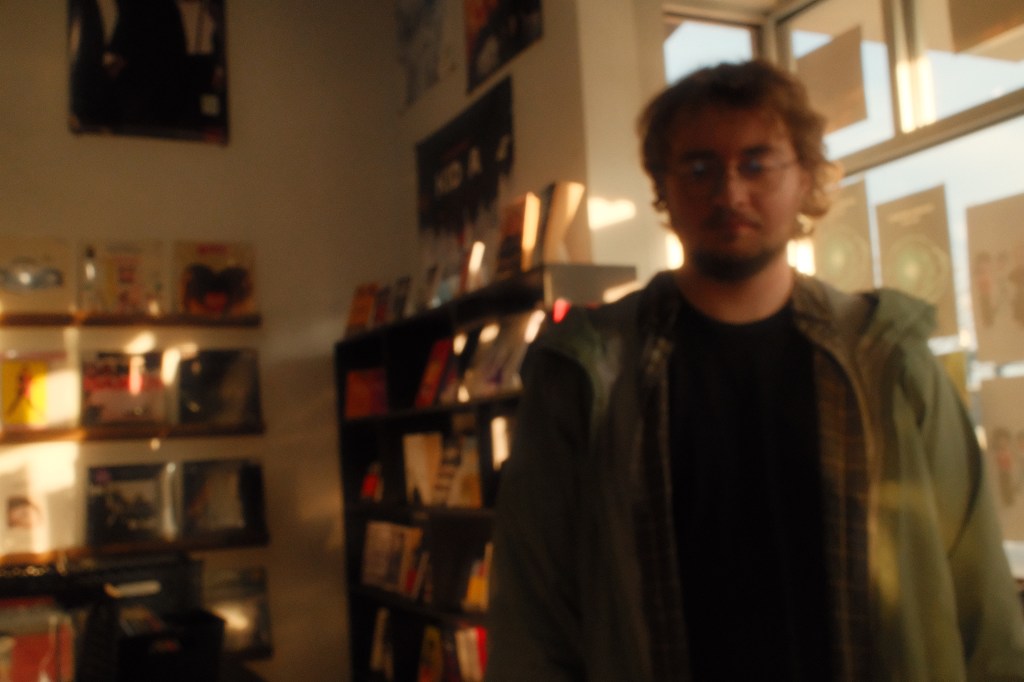
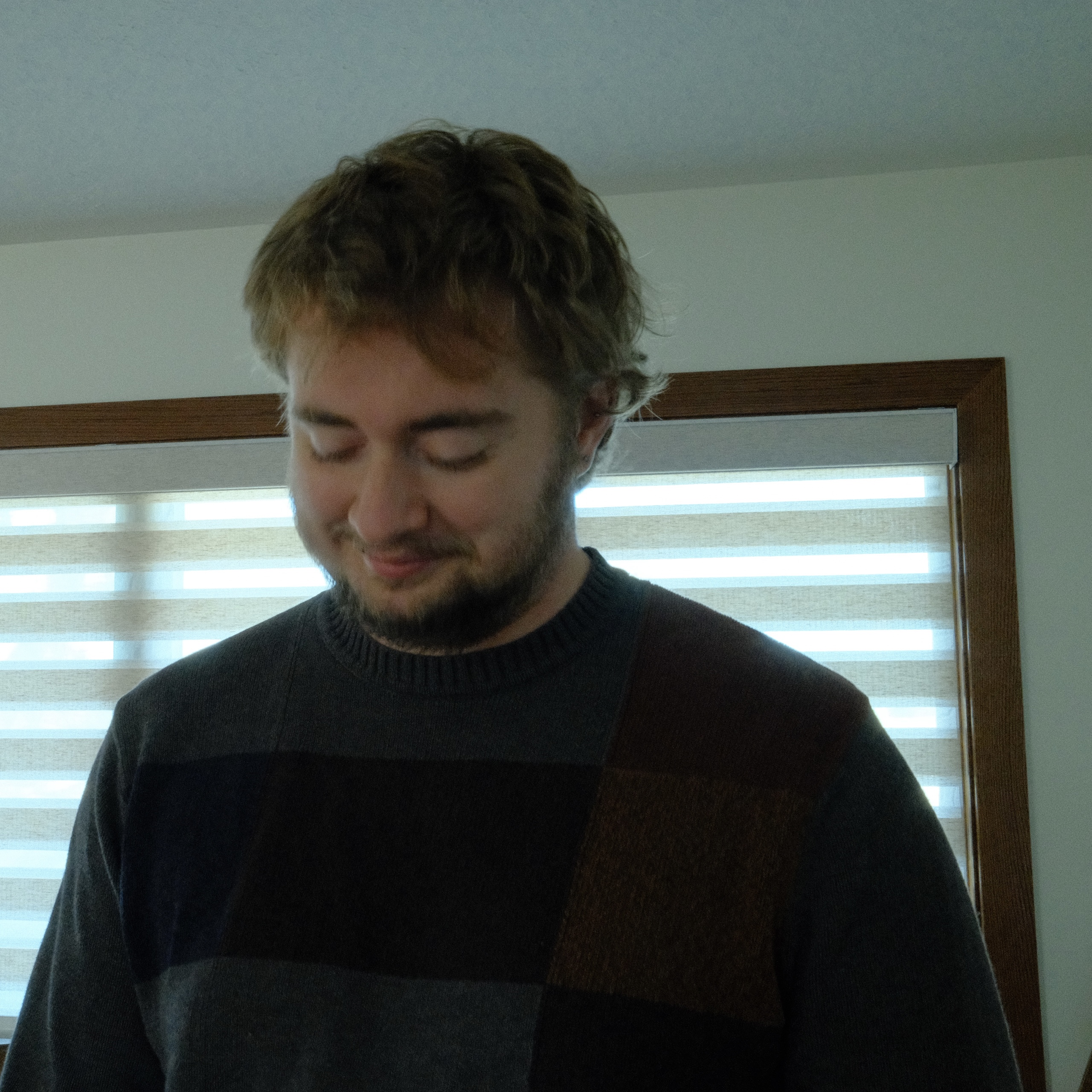
Donovan Andrews is a recent Hastings College graduate with a B.A. in General Music and two minors in Music Performance (Emphasis in Composition) and Education. When not experimenting with sound, he enjoys reading Dune, going for bike rides, and putting too many hours into Ultrakill.
Donovan was known within Hastings, Nebraska, both as a participating and helpful community member and composer.
Since moving to Omaha, his sonic experimentations have been largely related to solo electronic/electroacoustic, though he continues to compose for contemporary performers. He has been primarily working with cassette tapes/loops, Eurorack modules, and feedback.
Donovan’s piece, Pigs, was selected for the 2025 New Music on the Bayou Festival, and his installation, All songs composed are a dirge, is currently being presented at KOA Art Gallery. Balloon Parade and For the Fallow One were both premiered at Stone Quarry Art Park.
Donovan’s teachers include Dr. Anthony Donofrio and Dr. M. Joseph Willette.



Short Bio
Donovan Andrews is a composer and sound artist based in Omaha, Nebraska. He composes acoustic music for contemporary performers, as well as experiments with electronics to create vast and meditative ambiances. He works both in acoustic and electronic spheres experimenting with at least one of five core concepts: context, delicacy, spaciousness, recycling, and human interaction. Many of his electronic experimentations are solo and focus on earthy, warm textures. His acoustic works are ensemble and community-based and encourage performer choice.
Donovan earned his Bachelor’s of Music at Hastings College and studied with Dr. Anthony Donofrio and Dr. M. Joseph Willette. He has had his compositions performed at New Music on the Bayou and Stone Quarry Art Park, and an installation at KOA Art Gallery.
Artist Statement
I use sound to explore the subjectivity created by the constellations of culture, environment, and the individual. It begins with something so small as the oscillations of sound waves. Before the brain interprets them as sound, they have been shaped by the surrounding environment and altered in ways that create new and/or different forms. The listener’s brain transmutes these waves from microscopic vibrations to grandiose feelings of pleasure and displeasure. This is the inflection point where a listener’s subjectivity creates what they hear. I want the audience to become collaborators with chance, location, and the limitations of audio equipment in creating music.
October 2025
There are five concepts that primarily influence my work as a composer: Context, delicacy, spaciousness, recycling, and interaction. At least one of these is found in each of my works.
Context – When observing the concept of noise, it can be defined as spikes encompassing the entire spectrum of frequencies. When you take away these various recurring and spontaneous frequencies, you can begin to make out sounds or timbres. Conversely, continually adding sounds in a performance setting has the potential to bring out noise, both in a literal, technical sense and in a subjective sense. Noise, whether it be the two types I described or the noise that is considered “musical,” can be interpreted differently due to an individual’s social, cultural, and physical context.
Delicacy – A delicate performance, to me, is the most captivating one. I find that delicacy can be defined by the quietness and silence of a performance. Both of these qualities have both a gravitational and buoyant nature to them.
Spaciousness – A soundscape is appealing to my personal interests as a composer and a listener. I am fascinated by the idea that a musical landscape has the potential to envelop, cover, and hug an audience member. I refer to the visual arts for reference to this and the capabilities of mastering hundreds to thousands of brushstrokes to create the notion that something is there. This explores a sort of liminal and ambient space of music that I think is not explored nearly enough.
Recycling – Recently, I have begun experimenting with found objects. Due to personal beliefs, I take particular interest in utilizing unused objects and nature objects (given that they don’t harm any living things). The sounds that you can create from these objects that most people don’t often appreciate are a way for me to bring these things into the limelight and provide an opportunity for contemplation on the audience’s behalf.
Interaction – The interaction of elements is essential to music. I attempt to find ways to get performers or audience members to interact with the music, environment, or others as a way of finding themselves fully within the music. One of the most prominent features of my works is the utilization of performer’s choice, in which this concept is exhibited.
April 2025
I am obsessed with the idea of context.
I work towards seeing how much I can take away or provide to a listener to the point where they consider what they are listening to as music. If I provide layers of melodic lines to a listener, at what point does it become noise? The music could mean something entirely different to each individual that could be affected by a physical influence or something more abstract and non-physical, where someone has more tolerance for unconventional and experimental music, which makes an experience of listening to music like that more enjoyable.
I strive to create an enjoyable experience for at least one group involved in a performance: the performer(s) or the audience. For performers, I enjoy providing open-endedness in what I write to provide a chance for performers to take control, as opposed to me telling them exactly what I want them to do. For an audience, the term “enjoyable” is far more subjective due to the statement mentioned above. However, I like to write more meditative works that are, at the very least, entertaining to me and, by extension, entertaining to an audience.
Much of what I write is influenced by so many other mediums. This influence also creates a desire to recreate what can be found in other creative endeavors. I find it interesting how a photo of a meadow can be as meaningful as a novel, how a novel can express words the way a painting expresses through brush strokes, and how a painting can create a liminality that music invites through sound.

